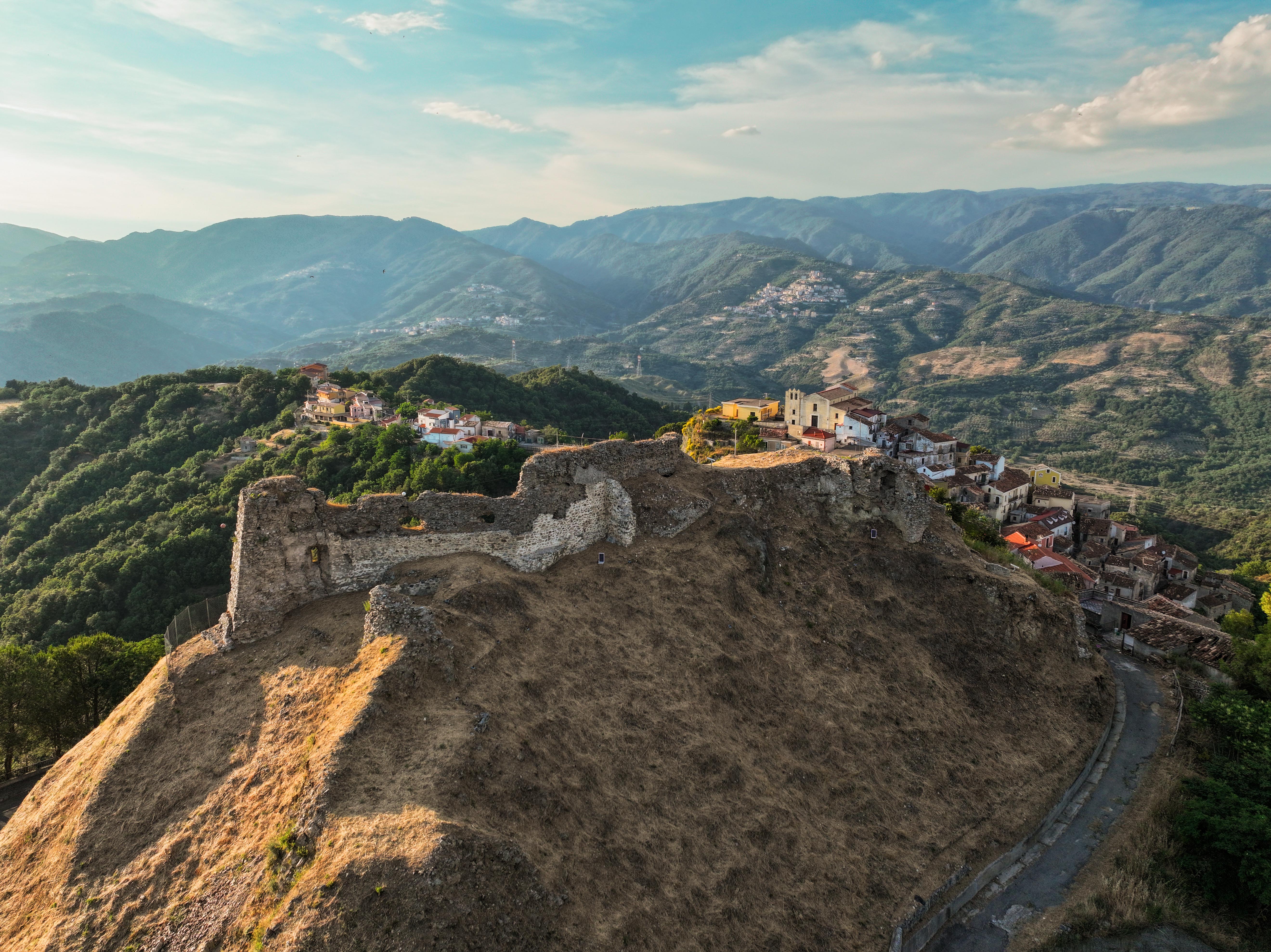
castello inglese
0:002:30
Sellia suffers from a considerable lack of written sources, particularly for the centuries before the thirteenth, perhaps because archival documents were lost following bombing or because some sources remain unpublished. The origins of the settlement are lost in the legend of its refoundation linked to Trischene/Trium Tabernarum, together with Taverna Vecchia and Simeri; the etymology of the place name itself may point to a Byzantine presence in the area.
1272 – First certain historiographical mention: a document issued by Charles I of Anjou warns Berteraimo de Malamorte not to disturb the possessions of Guglielmo, lord of Sellia (REG. ANG. Vol. VII, no. 355 and no. 363).
1280 – Charles I orders Goffredo di Sumesot, Justiciar of Valle Crati and Terra Giordana, to detach Sellia, together with Simeri, Taverna and Barbaro, from his justiciarship and attach it to that of Calabria (C. Minieri Riccio, 1875-1880).
1282 – During the War of the Sicilian Vespers, Charles I entrusts the defence of Sellia, Simeri, Taverna, Barbaro and other settlements to Bertrando D'Artois (C. Minieri Riccio, cited in E. Pontieri, 1950).
Thirteenth-fifteenth century – For this period, the only available reference is the work of Father Fiore of Cropani, "La Calabria Illustrata" (seventeenth century, reprinted under the editorship of U. Nisticò, 1999). It tells us that in 1399 Sellia was under the rule of Guglielmo Mazza, whose descendants held it until 1466, when it passed to the Sersale barons.
1439-1459 – The revolts of Antonio Centelles in the Kingdom of Naples directly involve Sellia. By marrying Enrichetta Ruffo, Centelles acquires the Ruffo family estates in Calabria, triggering wars against Ferdinand of Aragon; after his defeat and royal pardon, he returns to Calabria in 1458-59 and incites the Calabrian feudal lords to revolt. Sellia, together with Catanzaro, Taverna, Simeri and Zagarise, becomes a theatre of conflict (source: E. Pontieri, "La Calabria a metà del sec. XV e le rivolte di Antonio Centelles", based on "Codice Aragonese" and "Diurnali del duca di Monteleone").
1466-1662 – At the end of the revolts, Sellia is taken from Centelles and entrusted to Baron Bartolo Sersale of Cosenza; the Sersale family rules the fief until 1662.
1662-1806 – The fief passes to the Perrone barons of Rossano, whose founder was Giovan Lorenzo. They retain it until feudalism is abolished in 1806, although they continue to live in the baronial palace at the foot of the castle until it is destroyed by the landslide of the 1940s.
Between 1939 and 1949, the granite massif on which Sellia stands was affected by a massive landslide that opened on three fronts: one to the south, near the castle ruins, and two on the north-eastern slope of the settlement. The event wiped out much of the district below the fortress and the baronial residence, severely compromising the castle's original structure, of which only a portion remains today.
The surviving walls, however, are preserved in three main sections and were built using a rubble-core technique: two faces of split and dressed granite blocks with a filling of mortar and granite fragments.
On the basis of period photographs, particularly one taken in 1935, and the morphology of the site, it is thought that the castle stood on a broad plateau with sheer walls and had a central keep and at least two towers along the curtain wall, now largely swallowed by the landslide.
In addition to the castle, evidence has been found of a town wall and two gateways into the village: the "Portabella" to the east, with a double vaulted-arch passageway whose masonry can be dated between the eleventh and twelfth centuries, with roof-tile wedges dated between the fourteenth and fifteenth centuries; and the "Porta di Montagna" to the west, near the structure known as "il Ponte". Both were defended by semicircular towers. Together, these remains suggest a unified defensive system centred on the castle, whose earliest phases can be dated to at least the tenth-eleventh century, with later rebuilding.
* Source: "Fortificazioni medievali nell'area presilana catanzarese: i casi di Sellia, Simeri e Taverna Vecchia", Postgraduate Specialisation Thesis in Medieval Archaeology, Chiricò Lorenzo Antonio
castello inglese