The Golden Breath of Sellia
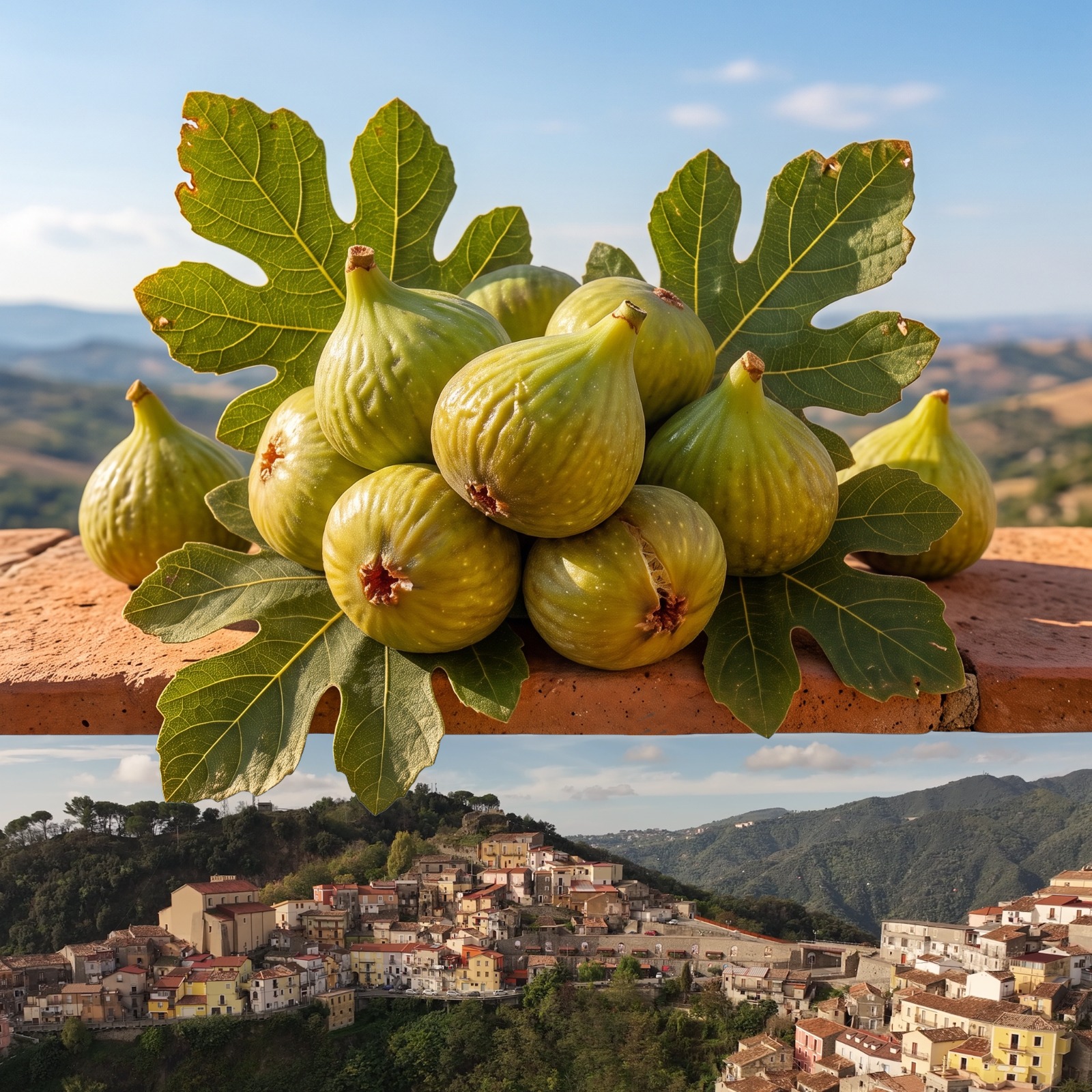
The August sun in Sellia does more than warm the earth; it paints it gold and fills it with ancient scents. Walking through the lanes that climb the hill, the gaze drifts towards the horizon, the same horizon that centuries earlier had watched Greek and Roman settlers plant the first fig trees. Those plants, arrived as barter goods, had found a second homeland in the Calabrian soil, putting down roots so deep that they became the very soul of the village.
For the elders of the village, the fig was simply the “bread of the poor”. In hard times, when flour was scarce, a handful of those fruits – fresh in summer or dried for the winter – was enough to give the farmers the strength to break the earth and the children what they needed to grow up healthy. Among all the varieties, the Dottato tree was treated with the respect due to a nobleman. It produced fruit with a smooth skin, shaded green and yellow, hiding a heart of red pulp, wonderfully sweet and almost seedless, so tender and digestible that mothers used it to wean their newborns.
Life in Sellia followed the rhythm of those palmate leaves. In June, when the air grew mild, came the fioroni, large and proud, a gift of late spring. But the real magic began in late summer, with the true figs, the "forniti". It was in August that the farmers moved among the branches with expert hands, searching for the passaluni: figs that the scorching sun had already begun to dry right on the tree. They picked them one by one, strictly with the stalk intact, so as not to let a single drop of their nectar go to waste.
In the courtyard of every house, the same scene had repeated itself, unchanged, for generations. Out came the cannizze, large racks of hand-woven reeds. There the figs were laid belly-up, exposed to the blazing Mediterranean sun. The most delicate task fell to the women and the elderly: turning the fruit methodically, day after day, with ritual patience, until it had lost about a third of its water, concentrating all the sweetness of summer into a soft, amber bite.
In those years, Sellia was a busy hive. Consumption was so high that in the neighbouring villages its inhabitants were jokingly nicknamed “mancia ficu” — fig eaters. But it was not just self-sufficiency. That small, generous fruit meant economic redemption for many families: buyers came all the way up there, above all from nearby Catanzaro, with carts and empty sacks, ready to pay the farmers to secure that dried treasure.
Summer, however, did not die in September. The summer's work on the cannizze found its fulfilment months later, when outside the wind lashed the alleys and Christmas was at the door. In the kitchen, the air grew warm and spiced. The dried figs were opened like a book and arranged to form a cross. In the centre went the filling: a crunchy walnut kernel, a small piece of orange or mandarin peel, and a pinch of cinnamon. Then another pair of figs was laid on top to close the cross, sealing the “crocette”.
The final passage through the wood-fired oven released a heavenly scent. In those golden, fragrant crocette, Sellia's winter found once more, intact and safeguarded, all the warmth of the August sun.
Gallery