
chiesa s.s. rosario inglese
0:003:16
Located in the upper part of the village, the Church of the Most Holy Rosary was built between the end of the seventeenth and the beginning of the eighteenth century as the seat of the confraternity of the same name. The building's architecture is the result of a complex stylistic stratification, produced by interventions and restorations carried out over time.
A moment of profound transformation came with the devastating earthquake of 1783, which caused serious damage to the original structure. During the subsequent restoration work, the church underwent decorative alterations in keeping with the taste of the period, although they were integrated organically and continuously with the pre-existing elements.
Further modifications, carried out over the following two centuries, significantly altered its original spatial arrangement: between the 1950s and 1960s, the left aisle was withdrawn from liturgical use and converted into a parish hall for association activities, catechism and film screenings, with the consequent demolition of the adjoining rooms that housed the choir.
The three-aisled configuration was completed by the construction of the right aisle, begun in 1909 at the behest of Prior Nicola Mannarino. The history of this work and the profile of the deserving prior are recorded in a marble inscription preserved inside the church:
“Nicola Mannarino, son of Michele, born in Sellia on 21 July 1839, died on 30 July 1909. For forty years, with loving intelligence, he worked for the prosperity of this Confraternity. A deserving Prior, with tireless zeal and affection he restored this church, enriched it with marvellous furnishings and built a new aisle. He was a scrupulous administrator and an exemplary citizen, upright and charitable. The brothers of the Most Holy Rosary, in perpetual memory of his outstanding virtues, unanimously resolved to dedicate this marble. 5 September MCMIX.”
Externally, the building is distinguished by an extreme and essential structural simplicity. The salients façade contains a central portal and two side entrances in wood, flanked on the left by the bell tower.
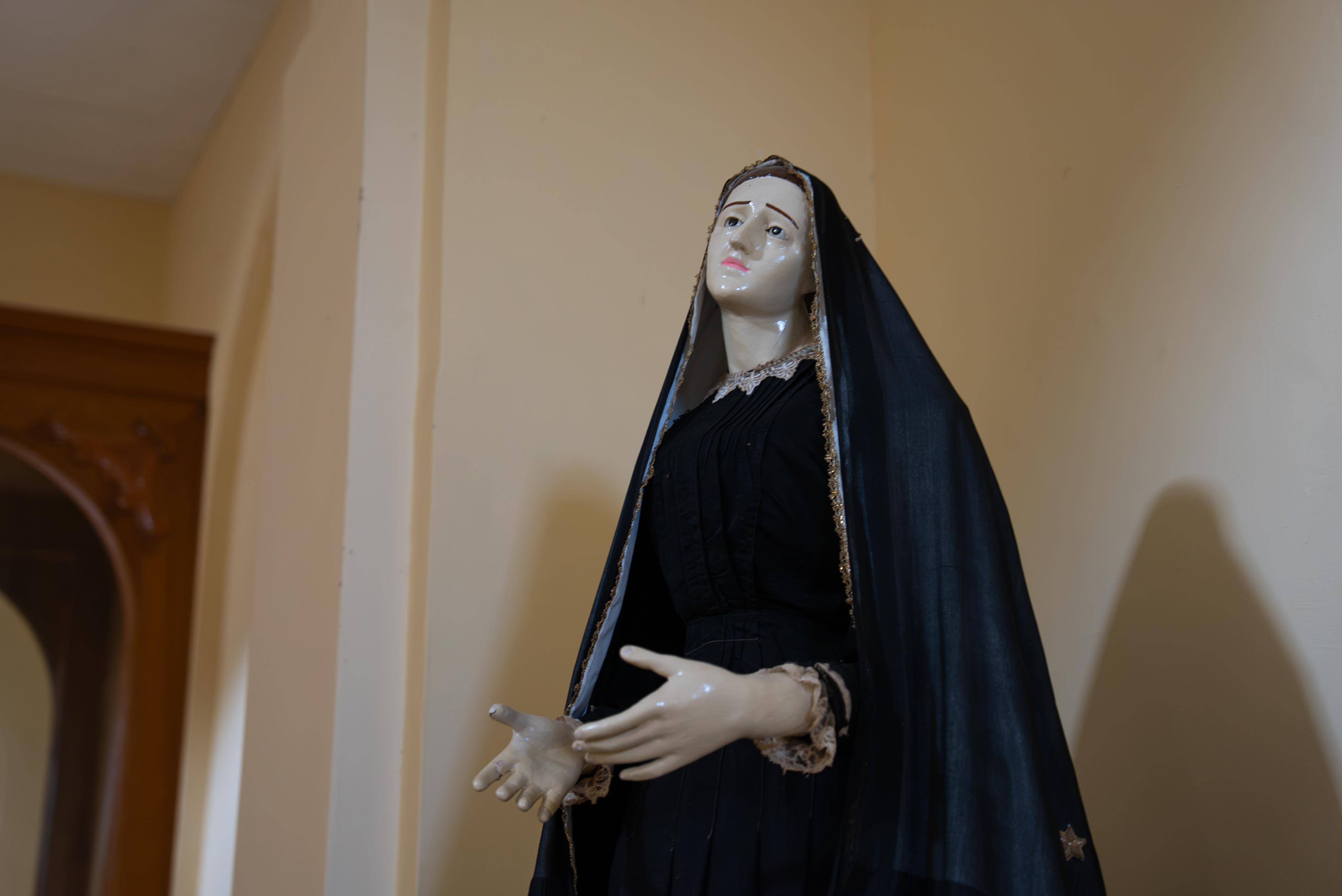
The interior, laid out in three aisles with a sacristy adjoining the apse, preserves precious elements of late-Baroque furnishing and decoration:
chiesa s.s. rosario inglese
 1 / 8
1 / 8