
The Salinella of Sellia
Sellia's ancient “Sila” water and the breath of a hidden land
The Song of the Salinella
There is a Calabria that makes no noise. Jealously guarded in the silence of its valleys and the embrace of its harshest rocks, it is an unexpected land that escapes the routes of distracted tourism and prefers to reveal itself only to those who truly know how to listen. There, where the slopes of the Apennines begin to descend gently towards the breath of the east-north-east wind, stands Sellia, a handful of houses clinging to history and suspended between the sky and a deep gorge. It is in this setting that, for centuries, a vital and miraculous lifeblood flowed, a liquid gem the ancients affectionately called “the Water of the Sila”: the Salinella spring.
Its story is not merely the chronicle of a water source, but a ballad made of footsteps, dreams, lightning-fast ascents and sudden silences. The Romans, masters at recognising nature's healing secrets, already found relief in it. But to find the first written words capable of capturing its essence, we must go back to 1659, when the earth shook fiercely in the Kingdom of Naples. Donato Antonio De Marinis, sent among the ruins of Calabria to report on the damage caused by the earthquake, was enchanted by this miracle hidden among the rocks. He wrote, with the wonder typical of great explorers:
“Ascending from Soveria higher into the Apennine mountains and always descending towards the east-north-east, there stands Sellia, three miles away. This land is famous for a renowned spring of salt water, from which a very great quantity of a salt with marvellous properties is obtained; it is almost the same as that of the true Epsom spring in England and is widely used in medicine.”
England's “Epsom salt” was already revered throughout the world. Yet, while across the Channel people knew how to preserve and market their wealth, the Salinella silently, almost modestly, treated local travellers and farmers as it awaited its redemption.
The Golden Age: When the mountain nourished the village
That redemption came at the dawn of the twentieth century. In 1915, official science finally bowed to the properties of this extraordinary spring. Professor Gouthier, professor of Hydrology at the Royal University of Naples, identified remarkable therapeutic qualities in it. It was a very pure, natural, purgative and decongestant remedy capable of awakening the metabolism. Soon afterwards, the University of Parma also confirmed that verdict.
It was then that Sellia experienced its sweetest springtime. The spring became the beating heart of the local economy, a promise of a future for dozens of families. At dawn, the procession along the steep paths began: men led the donkeys laden with barrels, while women walked with regal bearing, keeping wicker demijohns full of the precious liquid perfectly balanced on their heads. A proud journey up and down the slopes carried the water to the locality of “Guglielmo”, where a private company had built a modern depot. On 4 July 1925, a ministerial decree officially authorised the sale in Italy and abroad of “Acqua Sila — Sorgente Scenìa”.
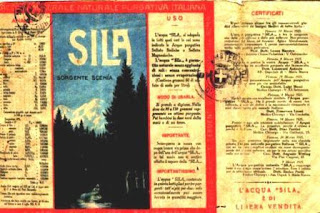
The bottles left for Naples, Rome and Florence; they crossed the ocean aboard transatlantic ships to reach the markets of America and Germany. The elegant red and blue labels, decorated with the silhouette of Sila pine trees and snow-covered peaks, bore instructions for that treatment which “does honour to our Italy”, as Dr Lazzaroni wrote enthusiastically in 1925. Distinguished physicians praised its effectiveness: Dr Leone Maestro even recommended it in paediatrics for its mild and safe action, while Dr Watting extolled its beneficial effects on the biliary tract.
The silence of the earth and the concrete prison
But beauty in Calabria is often fragile. In 1938, the Military Health Authority ordered the final emergency bottling before the failure of the management company silenced the machinery. Then, in 1949, nature decided to take back what it had granted: a devastating landslide slid down the valley, burying the spring and drawing a veil of silence over the Salinella. For decades, the water continued to flow invisibly beneath the debris, protected only by the childhood memories of the village elders.
Attempts to bring this dream back to life collided with bureaucracy and neglect. In the following years, a parliamentary question by the Honourable Bisantis tried in vain to revive institutional interest. In 1994, the Land Reclamation Consortium intervened to collect the waters once again, but did so with the delicacy of those who do not understand the sacredness of places: it was like entrusting the restoration of a china shop to an elephant. The spring was stuffed with cold reinforced concrete, disfiguring the natural beauty of a wild valley that even the ancient Romans had respected for millennia.
Today, the inside of the spring looks like a bare, silent concrete chamber. Yet behind that wall, the water continues to flow and whisper its ancient melody.
The Salinella of Sellia
The label of the Water of the Sila, made in Selly
The Calabria you do not expect. The one that, in some respects, still remains hidden. That surprises you when it suddenly reveals one of its gems. This is the case of the Salinella of Sellia. The Water of the Sila. That was what it was called. Known since Roman times and bottled for the last time in 1938 at the request of the Military Health Authority, which had expressly asked for it after the failure of the company that also handled its marketing. As far as Germany. As far as America. Then a landslide in 1949 brought down the curtain on this water that “does honour to our Italy”, as Dr Antonio Lazzaroni wrote on 9 March 1925.
The first scholar to discuss it was Donato Antonio De Marinis of the Kingdom of Naples. Commissioned to report on the damage caused by the earthquake of 5 November 1659 in the Province of Calabria, he expressed himself as follows:
“Ascending from Soveria higher into the Apennine mountains and always descending towards the east-north-east, there stands Sellia, three miles away. This land is famous for a renowned spring of salt water, from which a very great quantity of a salt with marvellous properties is obtained; it is almost the same as that of the true Epsom spring in England and is widely used in medicine.”
And everyone knows about English salt. Everyone talks about it. The so-called Epsom salt. Used as a laxative since ancient times. It eliminates liver stones and improves digestion. It has a worldwide market now. The English certainly know how to preserve their treasures.
In 1915 came the boom of Sellia's Salinella. Professor Gouthier, professor of Hydrology at the Royal University of Naples, found that it had remarkable health-giving qualities with purgative and decongestant effects, and recommended it as a natural remedy for obesity as well as an aid to proper metabolic function. These studies were later confirmed by Pier Carlo Federici of the University of Parma. At the beginning of the last century, Salinella water was a source of economic prosperity for Sellia, and many people worked there, travelling back and forth from the spring with loaded donkeys and women carrying wicker demijohns of the precious liquid on their heads as far as the locality of “Gugliemo”. There, a private company built a depot and, by a ministerial decree dated 4 July 1925, was authorised to sell it in Italy and abroad under the name “Acqua Sila”, as a national natural purgative mineral water.
The bottles bore a highly detailed label dominated by the name: Sila, Sorgente Scenìa. On the left were the results of the chemical and physical analyses carried out by Professor Gouthier. In the centre were instructions on how to use it:
Some opinions given by distinguished Italian doctors of the time. Including:
“Sila purgative water is one of the most effective and best tolerated of its kind. It causes neither irritation of the small intestine nor tenesmus. It acts mildly, promptly and reliably. It is therefore highly recommended even in paediatric practice. 18 March 1923, Prof. Dr Leone Maestro.
“I have used your Sila water in practice and have found it to be an excellent purgative that does honour to our Italy.” 9 March 1925, Dr Lazzeroni Antonio.
“I personally use Sila purgative water and am more than satisfied with it.” 19 March 1925, Comm. Dr Luigi Mauri.
“I have used Sila purgative water with excellent results. It has the great merit of being well tolerated and causing no pain, and I warmly recommend it to my patients, all the more because it is Italian.” 4 March 1925, Dr Francesco Leoni.
“For years I have widely prescribed the natural Italian purgative water Sila to my private patients, and it has given me the best results both as a decongestant of the enteric circulation and for its specific action on the biliary tract.” 20 March 1925, Cav. Dr Augusto Watting.
After the 1949 landslide, the Land Reclamation Consortium intervened in 1994. It was like entrusting the restoration of a china shop to an elephant. They failed to collect the groundwater properly, as the saying goes. And, even more outrageously, they packed the spring with reinforced concrete, disfiguring the scenic value of the valley, which not even the ancient Romans would have dreamed of touching.
Today the interest and sensitivity are right. What is missing is a feasibility study. And then, perhaps, we could say, as Lazzaroni did, that the Salinella of Sellia in Catanzaro does honour not only to Calabria, but to the whole of Italy.
Later, several years afterwards, the then Honourable Bisantis submitted a parliamentary question so that suitable funding might make it possible to resume exploiting the qualities of Sila water, but nothing happened. Only in 1994 was work carried out to collect the spring water, but to this day nothing suggests in the slightest that the exploitation of the water that conquered the American market in the 1920s will resume.
(The photograph shows the label placed on the bottles during the 1920s)
The inside of the spring, with drainage in the background
.
Gallery
 1 / 2
1 / 2